Most dogs don't hate having their nails trimmed. They hate the two seconds when something goes wrong. Get those two seconds right — the right tool, a small bite of nail, and a clear signal for when to stop — and the job becomes a quick weekly routine instead of a wrestling match. Here's how to trim nails so the nail, the quick, and your dog's nerves all come out intact.
Why Nail Length Matters
If you can hear clicking on the kitchen floor, those nails are longer than they should be. A dog standing still on a hard surface should have nails that just clear the ground, or barely touch it. When nails grow past that, they push the toes up and back, changing how the foot meets the ground. Over time that can affect the whole leg, not just the paw.
Long nails also catch on carpet, split, and curl into the pad on dogs who don't wear them down. Dewclaws are the worst offenders — they never touch the ground, so they grow in a circle if nobody trims them.
The tricky part: once nails are long, the quick inside them is long too, and you can't fix that in one session. Shortening a neglected nail takes a series of small trims every week or two while the quick slowly retreats. Plan for months, not one afternoon.
Know What You're Cutting
Each nail is a hard outer shell with a soft interior called the quick, which contains a blood vessel and a nerve. Cut into the shell and your dog feels nothing. Cut into the quick and you get blood, a yelp, and a dog who remembers.
On white and light-colored nails you can usually see the quick as a pink shadow through the shell. On black nails you can't see a thing, so you work by small increments and read the cut surface instead.
Reading a Dark Nail Without Guessing
Take off a thin slice, then look straight at the cut end. Far from the quick, the cut surface is a solid, dry grayish-white. As you get closer, a pale oval appears in the center with a darker, slightly moist dot inside it. That dot is your stop sign — put the clippers down and move to the next nail. If the surface looks pink, wet, or glossy, you're already at the edge.
Your fingers give you a second clue. A safe nail feels hard and cool. As you approach the quick it feels slightly spongy when the clipper closes. Spongy means stop.
Clippers or a Grinder?
Both work. They fail in different ways, so pick the one that suits your dog.
- Scissor or plier-style clippers — the standard choice. They take the nail in one clean motion, which means less time near the quick and less chance of a gradual mistake. They can also crack thick nails if the blade is dull, so replace or sharpen them when they start crushing instead of slicing.
- Guillotine clippers — fine for small, thin nails. They struggle with thick terrier or large-breed nails and are harder to keep properly aligned.
- Rotary grinders — a sandpaper drum that files the nail down. You remove tiny amounts at a time, so overshooting the quick is harder, and the finish is smooth with no sharp edges. The trade-offs are noise, vibration, and heat: holding the drum in one spot too long warms the nail, and your dog will feel it. Touch, lift, touch again.
Many groomers use both: clippers to take the bulk off, a grinder to smooth and round the tip. Whichever you choose, keep styptic powder within reach. Cornstarch or a bar of plain soap pressed against the tip works in a pinch.
Hold the Paw, Then Find the Angle
Work on a non-slip surface with your dog standing or lying comfortably. Stand or kneel beside or slightly behind the dog rather than looming over the face, and tuck the paw gently back toward the body instead of pulling it forward. Pulling a leg straight out is uncomfortable and invites a struggle.
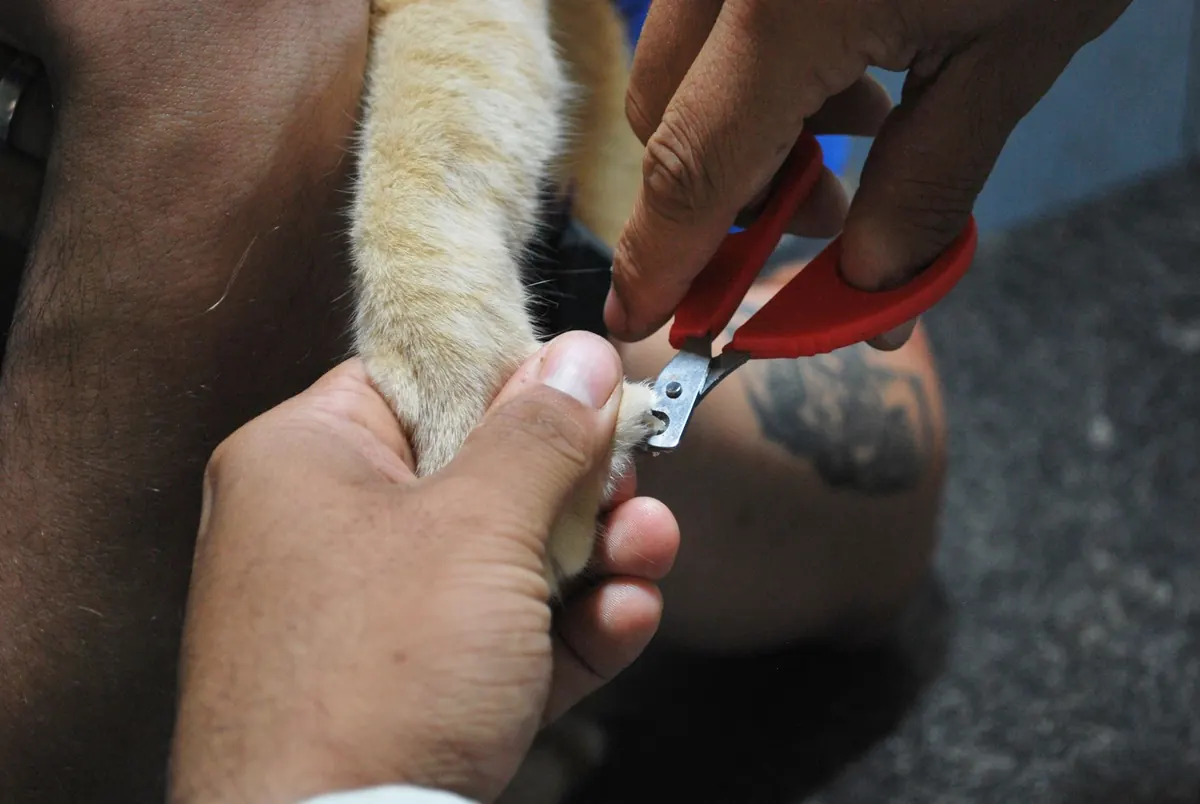
Cup the paw with your thumb on the underside, right on the main pad, and your fingers on top. Pressing the thumb upward spreads the toes slightly and holds one nail clear of the others. Don't squeeze the toes themselves — that's the part that hurts.
Now the angle. Set the clipper so the blade crosses the nail at a slight slant rather than straight down, following the curve of the nail toward the ground. A roughly 45-degree cut relative to the underside leaves a small, flat edge that's less likely to split than a long angled slice. Keep the clippers square to the nail and squeeze straight through — never twist or rock the handles sideways, which is how nails crack.
A Simple Routine to Follow
- Pick a moment when your dog is fed, walked, and calm — not when they're wound up. Have treats within reach before you touch a paw.
- Hold the paw, isolate one nail, and take a thin slice off the tip.
- Release, look at the cut end, and check for that pale oval or dark dot.
- Take another thin slice only if the surface is still solid and dry.
- Stop that nail the moment you see the dot, feel sponginess, or see pink.
- Treat, then move to the next nail. On a nervous dog, one paw per session is a perfectly good session.
When to Stop — and What to Do If You Cut the Quick
Stop trimming when any of these happens: you see the dark center dot, the nail feels soft, or your dog starts pulling the paw away, yawning, lip-licking, or trembling. Those last few are early stress signals, not stubbornness. Doing three nails calmly today beats doing ten today and none next month.
If you do nick the quick, stay calm and keep your voice level. Press styptic powder onto the tip with light pressure for thirty to sixty seconds. No styptic? Pack on cornstarch or press the nail into a soft bar of soap. Then give your dog a break, a treat, and a few minutes before deciding whether to continue. Minor nicks typically stop bleeding within several minutes, but if bleeding is heavy or won't stop after about ten to fifteen minutes, call your veterinarian.
Dewclaws and Dogs Who Need a Professional
Trim the dewclaws every time, even though they rarely touch anything. On the front legs they sit higher up the paw, and on many dogs the rear dewclaws are loose and wobbly — hold them steady between your fingers and cut small slices, because the quick tends to run further down than you expect.
Some dogs are better handled by a groomer or vet, at least while you build up. Puppies with no nail-trim experience, seniors with brittle or thickened nails, dogs with very long quicks, and dogs who panic the moment they see clippers all deserve a professional's hands. So do nails that are cracked, infected-looking, or surrounded by red, swollen skin — that's a veterinary question, not a grooming one.
Turn It Into a Two-Minute Habit
Trim a little every week rather than a lot every few months. Small, frequent sessions keep the quick short, keep the nails quiet on the floor, and give your dog dozens of calm repetitions instead of one stressful event. Keep the clippers somewhere visible, hand your dog a treat before you start, and finish while things are still going well. Do that for a few weeks and the hardest part won't be the trimming — it will be convincing your dog that two nails is genuinely all you're doing today.
Photo: Ermelinda Maglione / Pexels